
The Pentagon is planning for 90 days without the grid. Is your home Ready?
A battery gets you through a night. Getting through 90 days takes a battery and solar that refills it every morning. The Lion Den 90 Kit pairs the 3,000W Lion Safari with folding 24V solar panels, so the food stays cold, the lights come on and the radio keeps talking, day after day.

What's in the news
Military bases are being told to stand on their own
Fox News Digital reported Oct. 25 that Pentagon planning documents call for major U.S. bases to sustain essential operations for at least 90 days without outside power, fuel, water or supply lines.
Sources: Fortune · Anadolu Agency
The FORTRESS initiative, unveiled Sept. 30, lists large-scale battery storage, microgrids and strategic reserves among the ways bases would keep running when civilian infrastructure fails.
Sources: Anadolu Agency · IBTimes UK
The same week, Britain launched a campaign urging households to keep food, water and cash on hand to get through the first days of a disruption.
Source: Fortune
The Pentagon has confirmed FORTRESS publicly. The 90-day figure comes from reported internal documents, not a released directive, and it applies to military installations, not households. No one has said a 90-day blackout is coming. The point is simpler: the people who plan for worst cases plan in months, and a family can borrow the same logic. Lion Energy is not affiliated with the U.S. Department of Defense. Read the Snopes fact check.
Why a battery alone isn't a plan
Storage buys you days. Solar buys you months.
Every portable power station runs down. The 4,300Wh Safari with its XP pack carries a family's core essentials for about three days on its own. Past that, the only thing that matters is how much you put back in each day.
That's why every Den 90 Kit is built around solar. The four 100W panels in The Power Duo put back roughly 1,600Wh on an average fall day in the Mountain West, enough to cover a cold fridge, lights, phones and a radio, with the battery holding the reserve for cloudy stretches.
Usable AC energy stored in the Safari + XP. Spend it on day one and it's gone by day three.
What four panels deposit on an average fall day. It comes back every morning the sun does.
A day of core essentials. Keep spending under the paycheck and the savings never run dry.
Where a 1,300Wh day goes
Add a chest freezer, CPAP or Wi-Fi and the number climbs. That's exactly what the calculator below is for.
Run my own numbersThe Power Duo · core essentials (~1,300Wh/day)

The 90-day home plan
Three phases, one rhythm

Run on the reserve
- Start every outage with a full battery; the Safari holds a charge for up to a year in storage.
- Keep the fridge and freezer closed, lights on LED, phones charged.
- Set panels out the first morning, even before you need them.

Charge by day, use by night
- Face panels south and re-aim them at midday; clear snow and dust.
- Run heavy loads like a microwave or pressure cooker at noon, straight off the sun.
- Watch the battery in the Bluetooth app and ration on cloudy days.

Protect the essentials
- Rotate optional loads around the weather, food cold first.
- Keep a written log of what each day costs in watt-hours.
- No fuel runs, no oil changes, no fumes in the house.
Lion Den 90-Day Calculator
Will your kit make it to day 90?
Pick your region and season, check what has to stay on, and we'll run all three Den 90 Kits through 90 days of sun and cloud.

Where and when
What has to stay on
| Item | Qty | Watts | Hrs/day | Wh/day |
|---|
Your 90-day result
Recommended
The Power Duo
Your 90 days, one square per day
| Kit | Days full | Solar/day | Price |
|---|
Estimate only. Assumes 90% usable battery capacity, 88% inverter efficiency, a 0.8 solar derate, a full battery on day 1, and a repeatable 90-day weather pattern of clear, partly cloudy and overcast days averaged to your sun hours. Sun hours are planning estimates by region and season; enter your own if you know them. Real results vary with weather, panel angle, temperature and appliance age.
Lion 90-Day Emergency Plan
The Lion 90-Day Emergency Plan for Your Family
Tell us who you're planning for. We'll size the water, food and supplies for every person, then build a power plan from Lion's power stations and power banks.

Who are you planning for?
Children are planned at about 70% of an adult's food. Water, hygiene and light are planned per person.
How far do you want to build?
FEMA asks every household for at least 72 hours. Most families build up to 90 days a few weeks at a time.
Your supply list
What needs power each day?
Check what your family can't go without. Phones and lanterns scale with the number of people.
| Item | Qty | Watts | Hrs/day | Wh/day |
|---|
Choose your Lion gear
Not sure? Tap Suggest gear for my family and adjust from there.
Lion power stations and power banks
–
How the math works
enough for – with no sun
Why does one more solar panel make such a big difference?
| Solar panels | Solar per day | Days with everything on | Average day |
|---|
On a short day you still have power. You just ration: the fridge runs fewer hours, fewer devices charge, lights go off earlier.
Your 90 days, one square per day
Your gear: none yet
0 phone charges stored in power banks · total $0
Estimate only. Supply amounts are planning guides based on about 2,300 calories per adult per day and 1 gallon of water per person per day, the FEMA minimum for drinking and basic hygiene. Power assumes 90% usable station capacity, 80% usable power bank capacity after conversion, 88% inverter efficiency, a 0.8 solar derate and about 17Wh per phone charge. Power banks recharge from the power stations; only the stations take solar.
90-day plan · 4 people
Save your plan
Your full supply checklist and power plan on two printable pages.
Your gear: none yet
Gear total $0
Choose your kit
Three kits, all built for day 90
Every kit includes the Lion Safari, folding 24V solar, a 25′ extension cable and a Mil-Spec EMP bag for storage.
Real homes. Real outages.
Don't take our word for it
 1:19JoeMyHeck Cactus RemovalOff-grid on the job site
A desert work crew powering up with the Safari
Non-paid endorser
 0:38Mule Deer FoundationWhy they run the Safari
The Mule Deer Foundation on the Safari
Non-paid endorser

"…We continue to have frequent power outages and this presents a problem when our sump pumps kick on. We recently purchased another safari lion as well as 2 expansion packs. The solar panels are easy to hook up and do a great job of charging the unit while in use. We highly recommend this product!"
"I purchased the Lion Safari LT, because we do a lot of tent camping and I was hoping this unit would run my CPAP machine. I turn off the heated humidifier on my CPAP and this Lion Safari LT will run my CPAP for 4 nights no problem. The solar panel makes it very easy to recharge the unit. Great product and great tech support."
"I purchased a Lion Energy Safari power supply and Lion Energy Safari XP bundle… The bundle came with 6 solar panels and a 25ft extension cable… We have tested the system and feel this will power [our] refrigerator/freezer, lighting, fans or a heater, cell phones and devices during a power failure. This set is portable for camping or remote off the grid living."
See it work before you buy
 0:16Home backupThe fridge stays cold
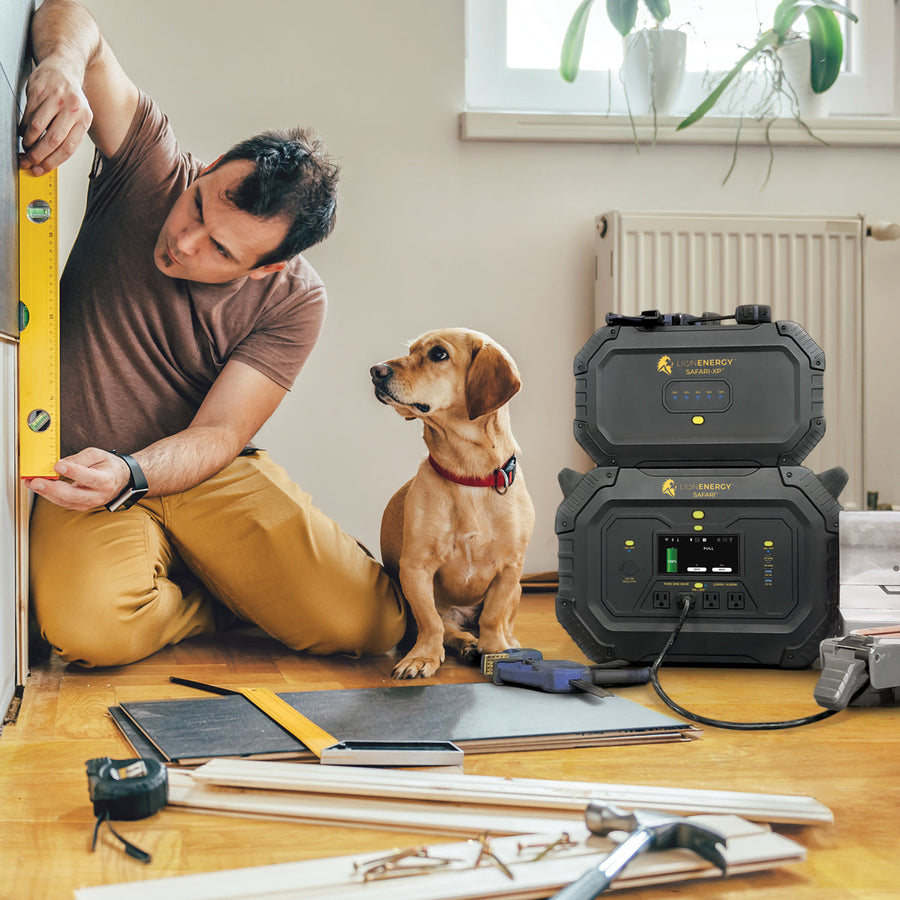
The Safari + XP running a full-size fridge
 0:13Solar at homeCharging on the deck
Refilling from 24V panels at home
 0:20Off-grid campPanels out, smoothies on
A desert campsite powered by the sun
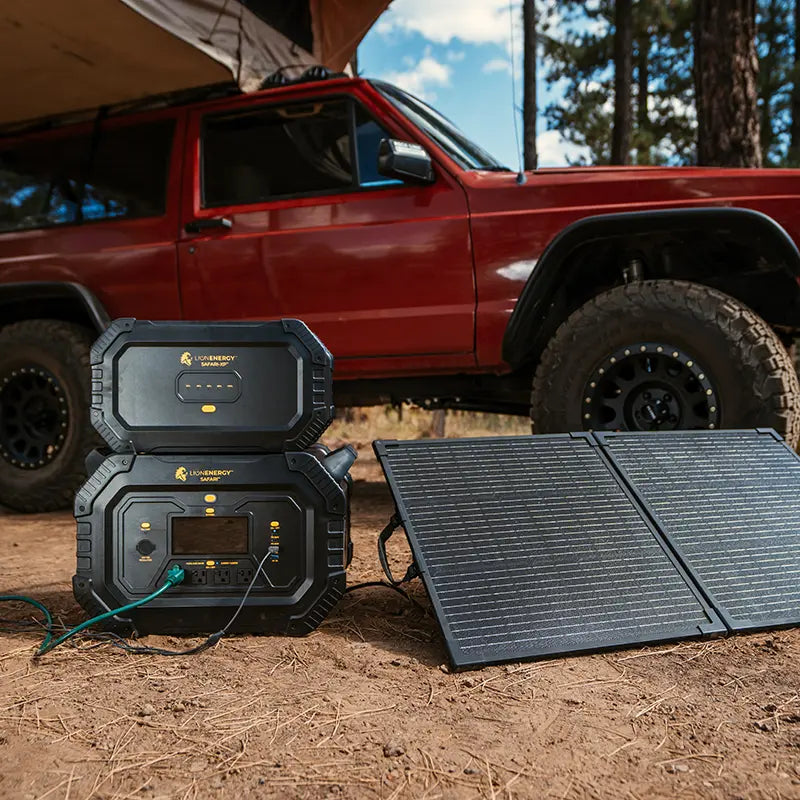
 0:38OverlandRooftop tent, full power
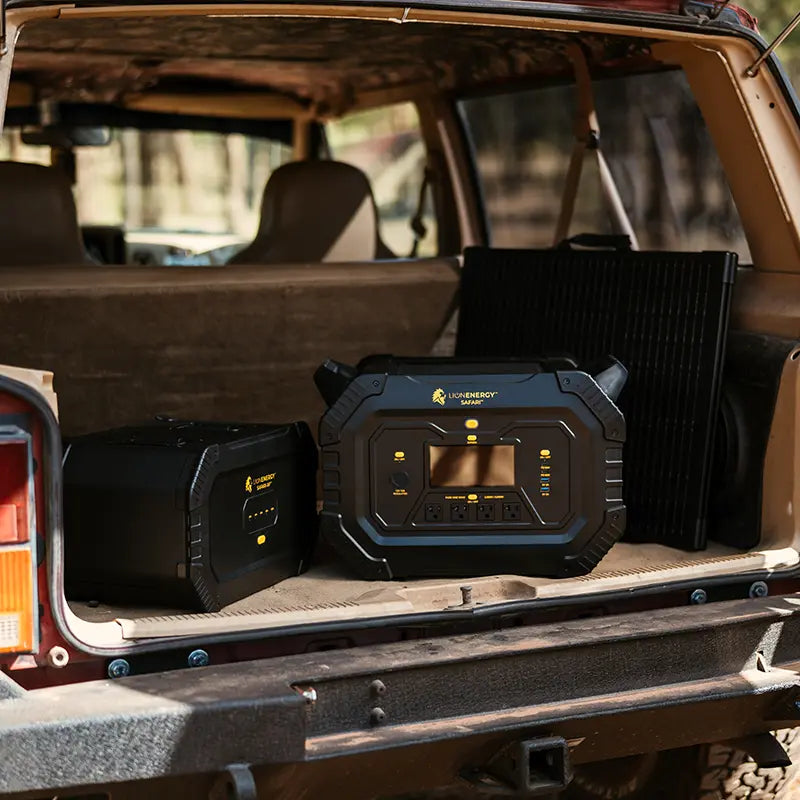
Safari + XP and solar on the trail
Why it's built this way
Plain-English answers to the specs
3,000W + 6,000W surge
Enough to start a refrigerator compressor or a saw without tripping. Most "small" units can't.
Pure sine wave
The same clean power as your wall outlet, so it's safe for CPAPs, laptops and sensitive electronics.
LiFePO₄, 3,500+ cycles
Lithium iron phosphate is the long-life, thermally stable chemistry. Charge it every day for nearly a decade.
Holds a charge for a year
Store the Safari up to 1 year and the XP up to 2 years. Top it off once a season and forget it.
Fast wall charging
Safari: ~2.3 hours from a wall outlet. Safari + XP: ~6 hours. Charge it the moment a storm is forecast.
Outlets for everything
AC outlets, 2× USB-C 60W PD, 2× USB-A, a regulated 12V socket and a NEMA TT-30 RV port.
Safe inside the house
Zero emissions and silent. No carbon monoxide, no extension cords out to the yard.
Firmware engineered in the USA
Lion designs its software and firmware in the USA. Bluetooth monitoring is built in for real-time readouts.
Protected by a smart BMS
Built-in protection against overcharge, over-discharge, short circuit, overload and overheating.
What plugs in where
Every outlet you need, built in
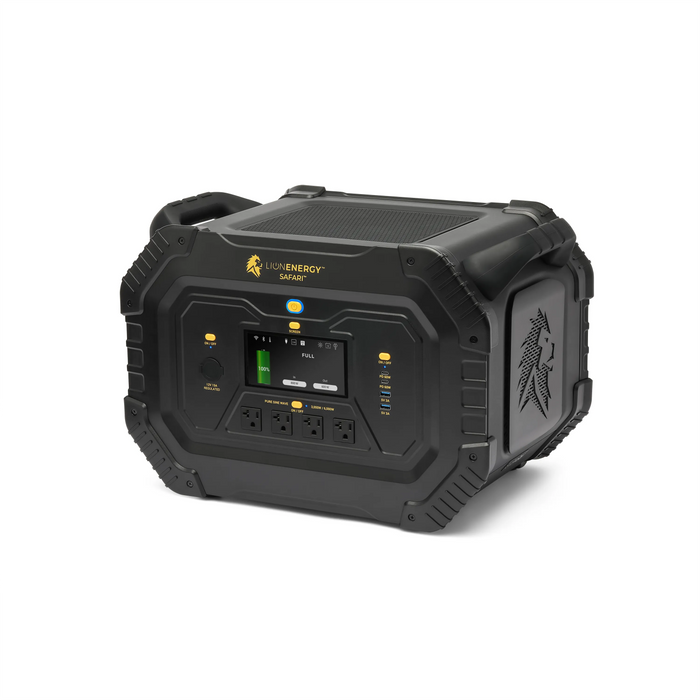
Pure sine wave AC on every outlet. Run the fridge, charge phones and power the trailer at the same time, up to 3,000W.
No installer needed
Up and running in 3 steps
- 1
Plug in the XP
On The Power Duo and Off-Grid Max, connect the Safari XP to the expansion port on the back of the Safari. Together they give you 4,300Wh.
- 2
Run the panels
Unfold the 24V panels in the sun and run the 25′ cable to the Safari's solar input. The Safari stays inside and dry.
- 3
Power on
Press power and plug in. The screen and the Bluetooth app show what's coming in and what's going out.
What's inside
Built from parts you can grow
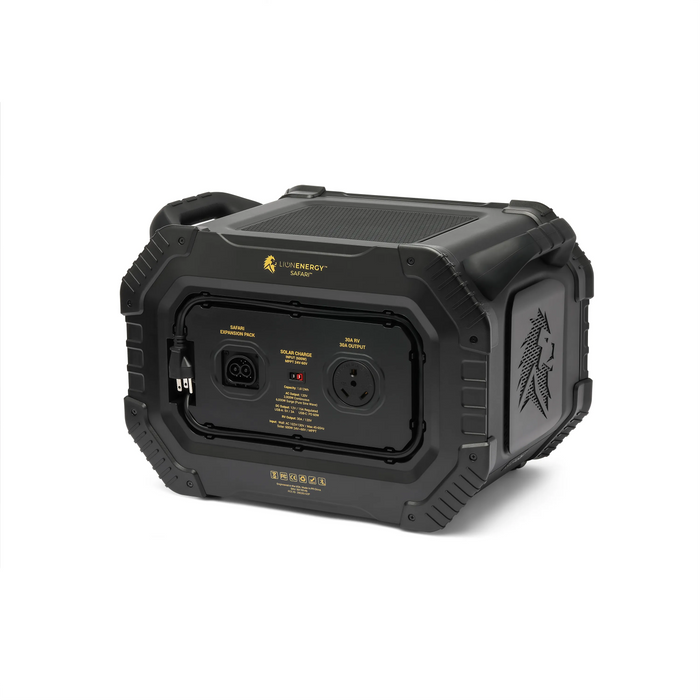
Lion Safari
3,000W pure sine inverter, 6,000W surge, 1,612Wh LiFePO₄, 30A RV port, Bluetooth monitoring. Rated 3,500+ cycles.
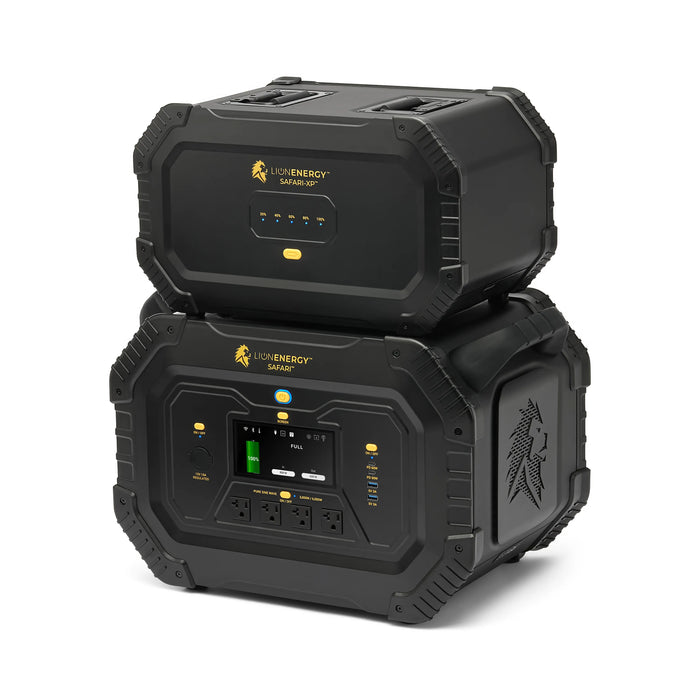
Safari XP
Plugs into the back of the Safari for 4,300Wh total. Holds its charge for up to 2 years in storage.
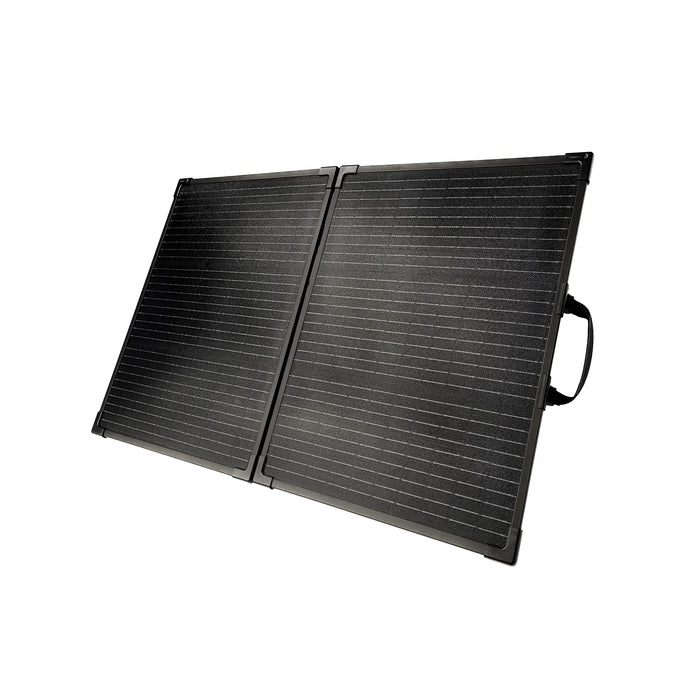
100W 24V panels
Folding monocrystalline panels with tilt legs and a neoprene case. Link up to six for 600W. 5-year warranty.
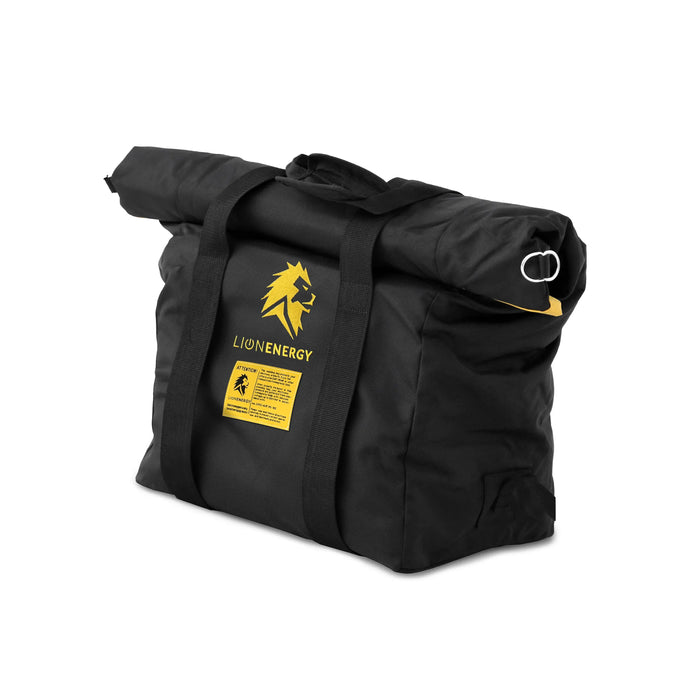
Mil-Spec EMP bag
Shielded storage bag for the Safari between emergencies. Included with every Den 90 Kit.
90 days, two ways
Den 90 Kit vs. a gas generator
| Lion Den 90 Kit | Portable gas generator | |
|---|---|---|
| Fuel for 90 days | None. The sun refills it. | A fuel stockpile you have to buy, store and rotate |
| Fuel shelf life | Not applicable | Gasoline goes stale within months without stabilizer |
| Indoor use | Yes, zero emissions | Never. Carbon monoxide risk |
| Noise | Silent | Loud, and it tells the neighbors you have power |
| Maintenance | None | Oil changes, carb cleaning, test runs |
| Storage between emergencies | Holds charge up to a year, in an EMP bag | Drain or stabilize fuel |

Built by a Utah company
14+ years of keeping families powered
Lion Energy has been building portable power and home batteries in Utah for more than 14 years. Lion designs its software and firmware in the USA, and when you call, you reach a Utah support team.
Questions
Questions, answered
Can a portable kit really last 90 days?
Only with solar. The battery covers the first few days and cloudy stretches; the panels refill it each day. Whether you make it to day 90 depends on what you run and your sun. Run your own numbers in the calculator above.
What can it run?
Anything under 3,000W continuous (6,000W surge) that plugs into a standard outlet: refrigerators, freezers, lights, CPAPs, routers, laptops, radios, power tools and short bursts of cooking appliances. Large heat loads like space heaters burn through a battery fast.
What happens on cloudy days?
Panels still produce, just less. The battery covers the gap, and you ration optional loads until the sun comes back. The calculator's ledger shows which days would be rationed.
How do I store it until I need it?
Charge it full, keep it indoors in the included EMP bag and top it off every few months. The Safari holds a charge for up to a year and the XP for up to two.
Is this connected to the Pentagon's 90-day plan?
No. FORTRESS is a Department of Defense initiative for military installations. The Lion Den 90 Kit is a home preparedness product, and Lion Energy is not affiliated with the Department of Defense.
What about my whole house?
For automatic whole-home backup, the Lion Sanctuary 3 starts at 28.6kWh and scales to 171.6kWh with up to 18kW of solar per inverter. It's installed by a Lion Certified Installer.
What's the warranty and guarantee?
[WARRANTY TERMS] · [GUARANTEE TERMS]

Whole-home backup
Want the whole house on the plan?
Lion Sanctuary 3 switches your home to battery automatically and stores your rooftop solar, from 28.6 to 171.6kWh.
Size my home systemDay 1 starts before the outage
Stock your den while the grid is still on.
Questions? Call Lion Energy: (385) 375-8191